
How to Calculate AI ROI for Your Business: Formula and Example
Calculate AI ROI with one formula: hours saved × hourly rate × 4 minus tool cost. The meeting notes example returns 1,600 PLN a month.

You can calculate AI ROI with three numbers: hours recovered per week, times your hourly rate in PLN, times 4 weeks, minus the monthly cost of the tool. In the meeting notes example, the result is 1,600 PLN a month. Below you will find the formula, two worked examples and five steps to take before every rollout.
Why do most companies not calculate AI ROI?
Almost half of Polish companies plan to increase their AI budget. Only 11.5% formally measure the return. The data comes from a Microsoft report described by Bankier.pl.
This gap means many budgets are set without any calculation. The tool costs money every month, and the benefit may be felt but never written down. After a few months, it is hard to tell whether the subscription pays for itself.
The calculation does not need a spreadsheet with dozens of tabs. Three numbers and one multiplication are enough. You can do it in a few minutes, before you buy.
What is the formula for AI ROI?
The formula looks like this:
hours per week × rate in PLN × 4 minus monthly cost
To use it, you need three numbers:
- hours recovered per week thanks to the tool,
- your hourly rate in PLN,
- the monthly cost of the tool.
The multiplier 4 turns the value of one week into the value of a month. It is a simplification, but it is enough for a quick assessment. A positive result means the tool pays for itself. A negative result means you are paying extra for it.
How do you calculate AI ROI using the meeting notes example?
Let us take the time a team spends on meeting notes. We will use Hindsight, a hindbrain Mac app for meeting notes with Polish transcription that runs locally. The numbers below are illustrative and come from a model example, not from a client project.
| Step | Calculation | Result |
|---|---|---|
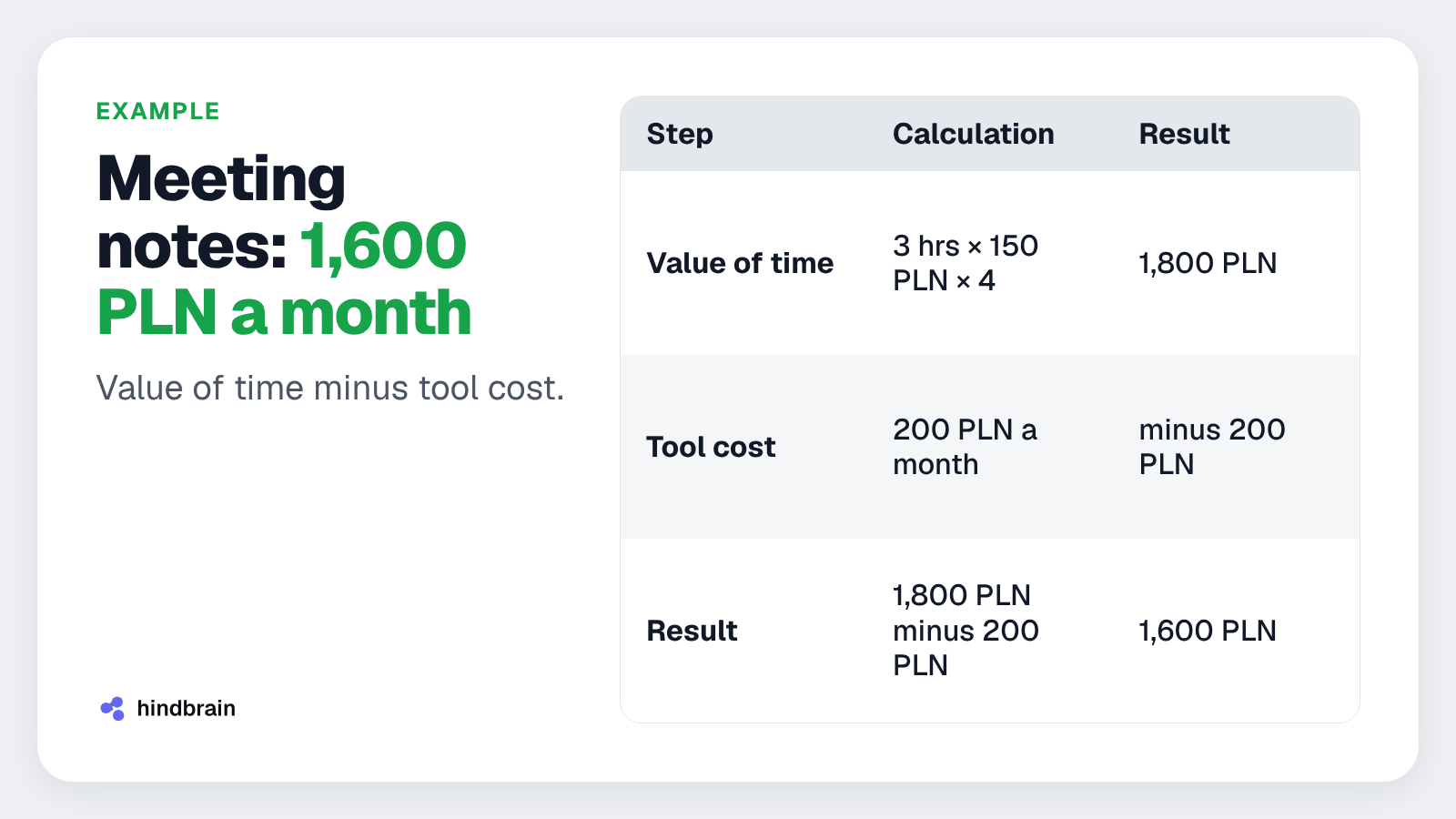
| Value of time | 3 hours × 150 PLN × 4 weeks | 1,800 PLN a month |
| Tool cost | 200 PLN a month | minus 200 PLN |
| Result | 1,800 PLN minus 200 PLN | 1,600 PLN a month |
The 1,800 PLN is the value of time. It becomes the result only after you subtract the tool cost, which gives 1,600 PLN a month. Under these assumptions, that is 19,200 PLN a year (model example).
It is also worth asking how many hours the tool needs to save before it pays for itself. At a rate of 150 PLN, one hour per week is worth 600 PLN a month. A 200 PLN tool therefore pays for itself at about 20 minutes a week (model example).
When does AI not pay off?
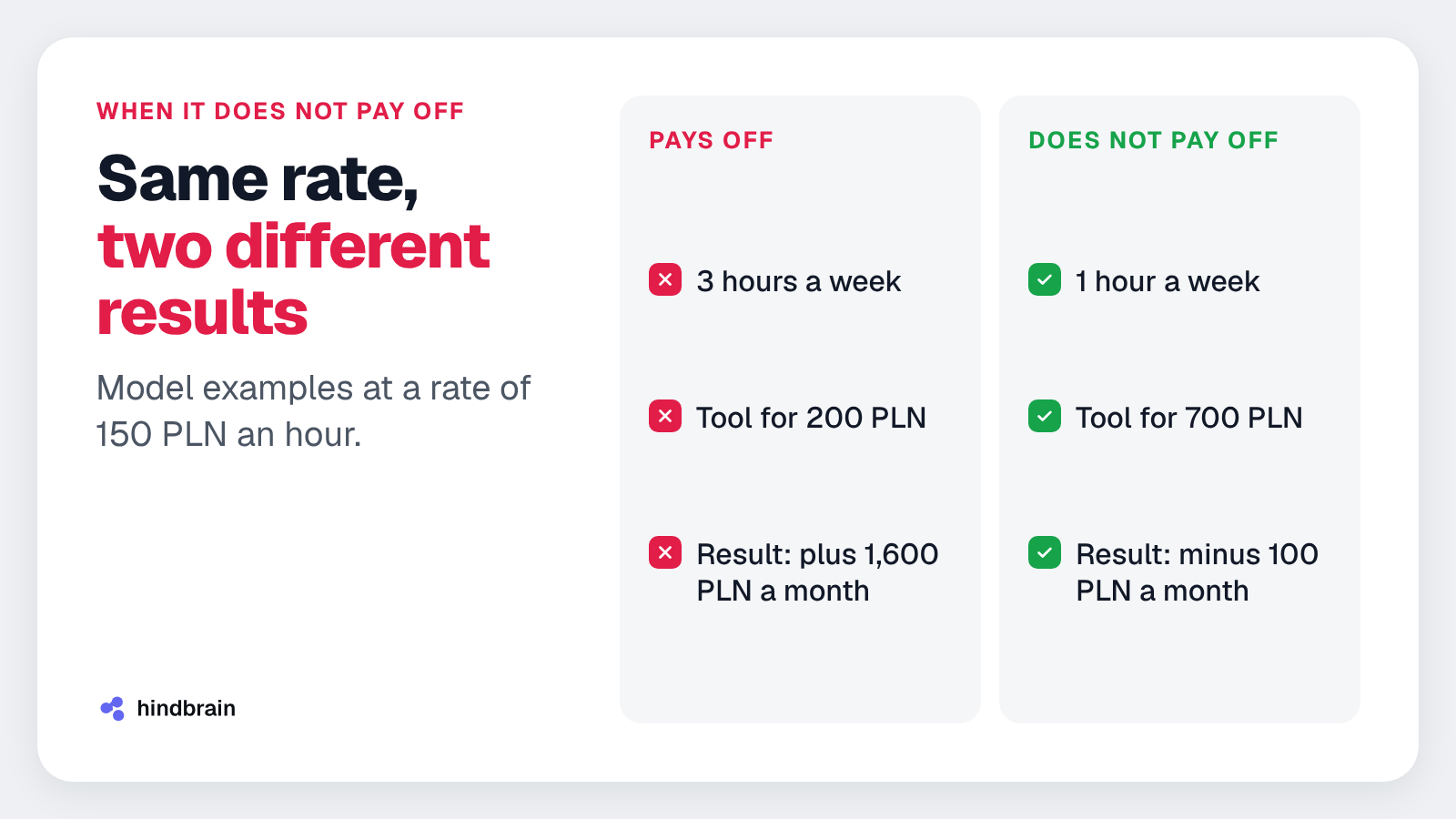
The formula also shows when a purchase makes no sense. Take 1 hour of recovered time per week and a tool costing 700 PLN a month. At 150 PLN an hour, the calculation is 1 × 150 × 4 = 600 PLN. After subtracting 700 PLN, you get minus 100 PLN a month.
Such a purchase creates a loss even if the tool works perfectly. For a 700 PLN tool to pay off at this rate, it must recover about 1.2 hours per week (model example).
With a negative result, you have two options. You can reduce the scope, for example by buying a cheaper plan or covering fewer people. You can also skip the purchase and return to it when there are more hours to recover. Both decisions are better than buying on a hunch.
Static preview — animation disabled.
How do you measure hours and rate so the result is reliable?
The weakest link in the formula is the hours, because they are easy to overstate. Everyone remembers meetings as long and notes as a chore. So measure the time instead of estimating it.
Five steps before every AI rollout:
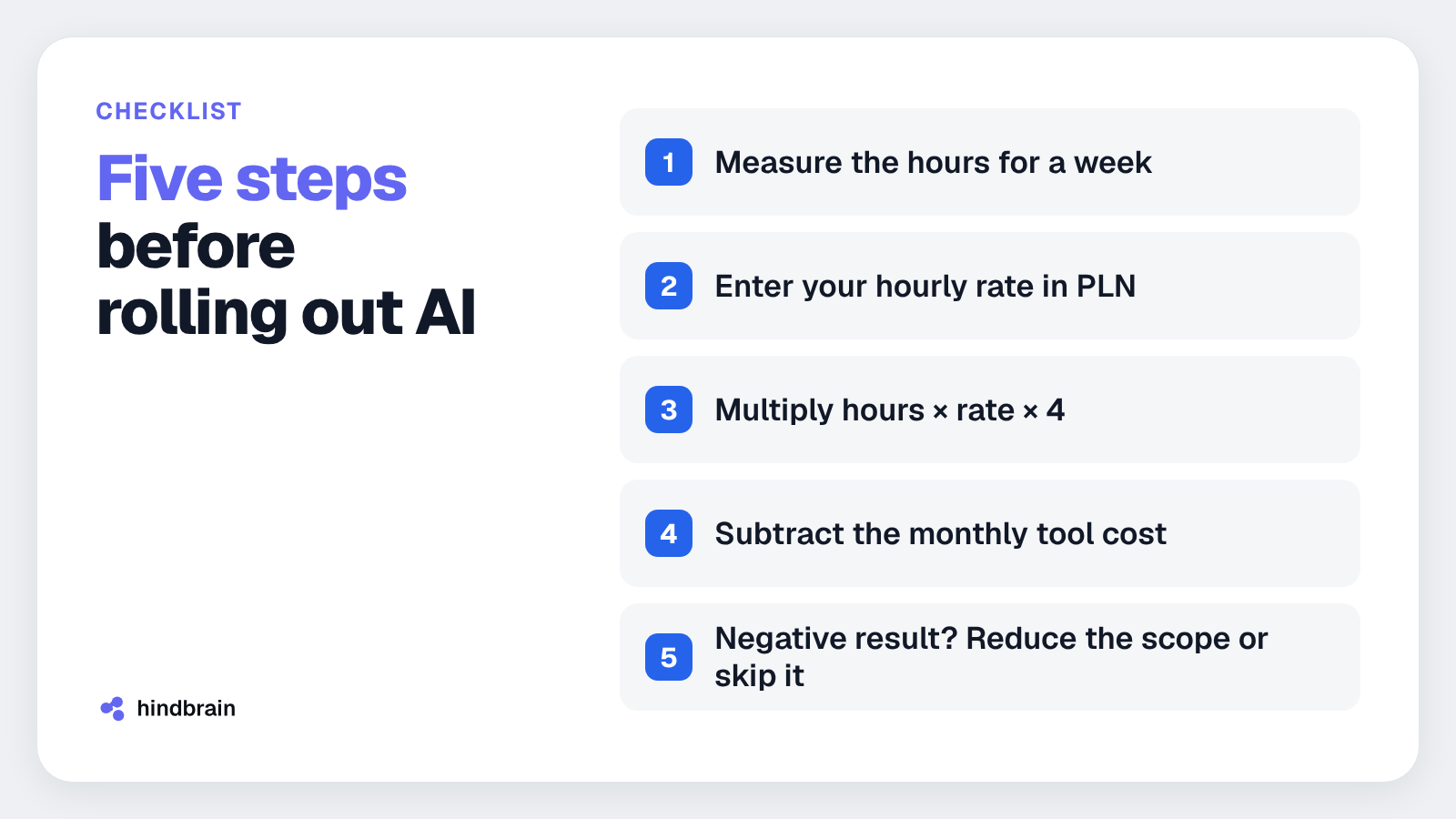
- Measure the hours for a week, do not guess.
- Enter your hourly rate in PLN.
- Multiply hours × rate × 4.
- Subtract the monthly cost of the tool.
- Negative result? Reduce the scope or skip it.
Add the cost of rollout and setup to the tool cost, spread over the months. If the tool is meant to use data from a CRM, email or spreadsheets, add the work of connecting the systems. We run such projects in the area of integration and automation. The fuller the cost, the more honest the result.
Choose your rate consistently. It can be the employer's cost divided by working hours, or a billing rate. What matters is using the same method in every calculation.
What should you do today?
Pick one repeatable process that takes your team the most time, for example meeting notes, retyping data or preparing quotes. For the next week, write down how many hours it takes in total. On Friday, enter the result into the formula and check whether the tool you are considering comes out positive.
If you do not know which process to pick, get in touch through contact. We will send you our checklist “20 processes to automate in your business”. It helps point out the tasks where there are usually the most hours to recover.
FAQ
What is AI ROI for a business?
AI ROI is the difference between the value of recovered time and the cost of the tool over the same period. You calculate the value of time as hours per week times your rate in PLN times 4. From that result, you subtract the monthly cost of the tool. A positive result means the tool pays for itself. A negative one means it generates a loss.
Where do I get the hourly rate from?
Use the rate of the person whose time the AI recovers. It can be the employer's cost divided by working hours, or a billing rate if you sell time to clients. In the example we used 150 PLN an hour. This is an illustrative number, so enter your own and keep one method in every calculation.
Is the 1,800 PLN in the example a cash saving?
The value of time becomes a saving when the recovered hours go into work that brings something in, such as sales, customer service or projects. If the time disappears without use, the calculation shows only potential. The cash result appears only when the time is put to use. So decide before the rollout what you will use the recovered hours for.
What costs should I add to the formula besides the subscription?
Add the cost of rollout and setup, spread over the months, and the team's time spent learning the tool. If the tool needs integration with a CRM, email or spreadsheets, add the cost of building it. The fuller the cost, the more reliable the result. The formula stays the same, and only the last number changes.
Does the formula work for uses other than meeting notes?
Yes. The formula works for any repeatable task that AI or automation shortens: retyping data, preparing quotes or answering enquiries. You only need the measured hours per week, your rate and the monthly cost. Meeting notes are just an illustration, because their time is easy to measure.
We can run the numbers together
The formula is simple, but it gives the most when you enter your own hours, your own rate and the real cost of the tool. If you want to check which processes in your company are worth automating and whether the result comes out positive, book a call. The first conversation is free.