The procedure Hindbrain uses to test backend, web, desktop and mobile apps, and security. Tick off items, print the documents and see what your project is missing.
A new product or a large feature goes to production. We fix critical and high findings before the start.
After taking over an app
You receive a system from another vendor. We check what really works before you build on it.
Once a year
The app is live. We repeat the full review because dependencies, permissions and configuration age.
How long it takes
A security audit of a typical B2B app takes 4 to 5 working days. The whole path depends on the number of branches: [NEED: time range of the full test path for web, desktop and mobile apps].
What you get
A findings report: description, evidence, business impact, CVSS 3.1 rating and step-by-step fix
An acceptance test protocol signed by both sides
A retest after fixes, in the same report
A list of what was checked with no reservations
A recommendation: ship or not
Test path map
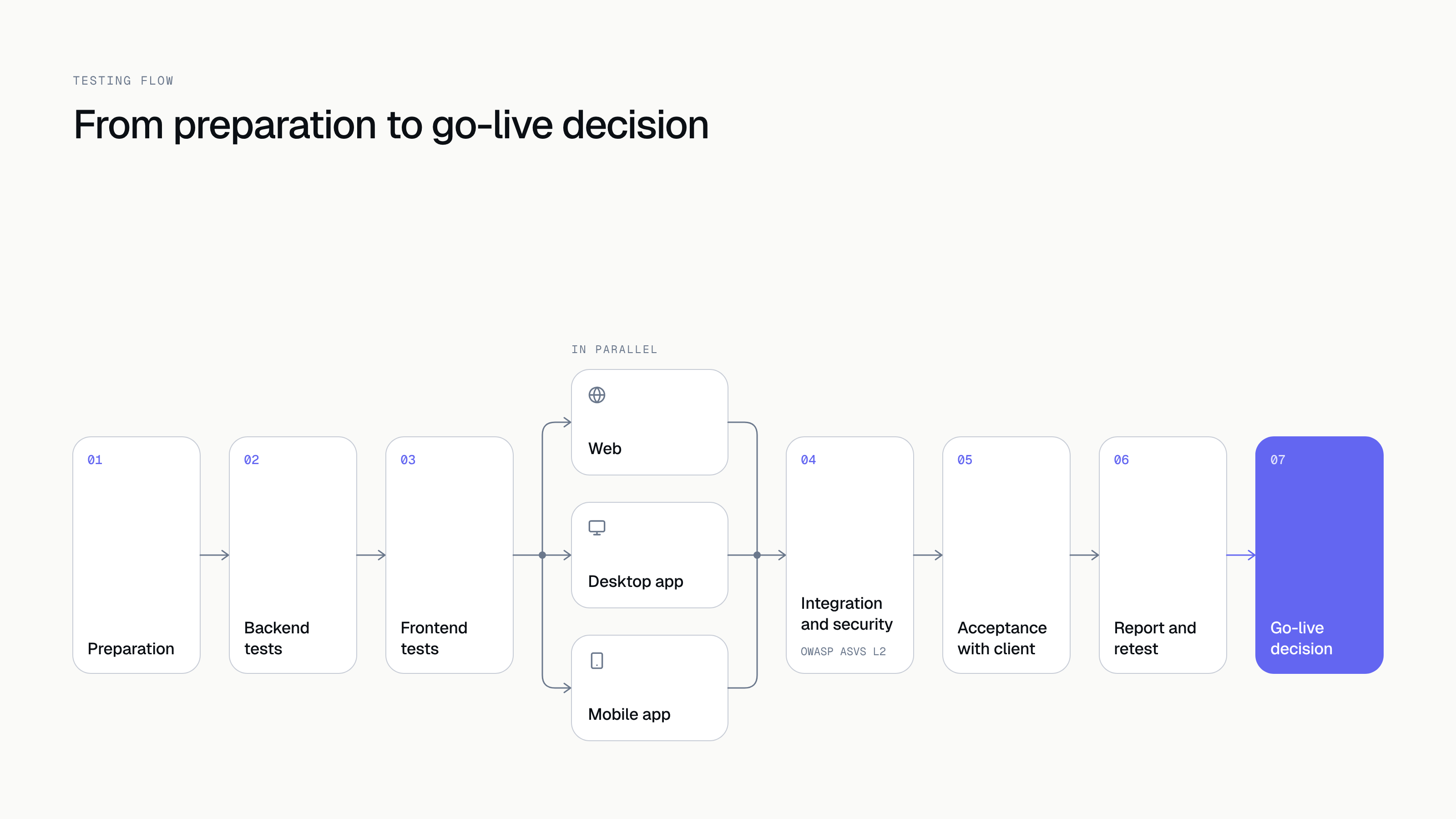
Seven stages in order. Frontend testing branches into web, desktop and mobile, then joins again in integration and security testing.
The test path from preparation to the go-live decision.
1
Preparation
Scope, consent to test, access, test accounts and staging. We do not start without them.
2
Backend tests
API, data, permissions, performance and backups.
3
Frontend tests
Web, desktop and mobile separately, depending on what you build.
4
Integration and security
Tests against OWASP ASVS level 2: automated scans, then manual verification of every result.
5
Acceptance tests
You walk through the scenarios on staging. The result goes into the protocol.
6
Report and retest
Findings report, fixes, a second test.
7
Go-live decision
Rule: a product does not ship with an open critical finding. You make the decision.
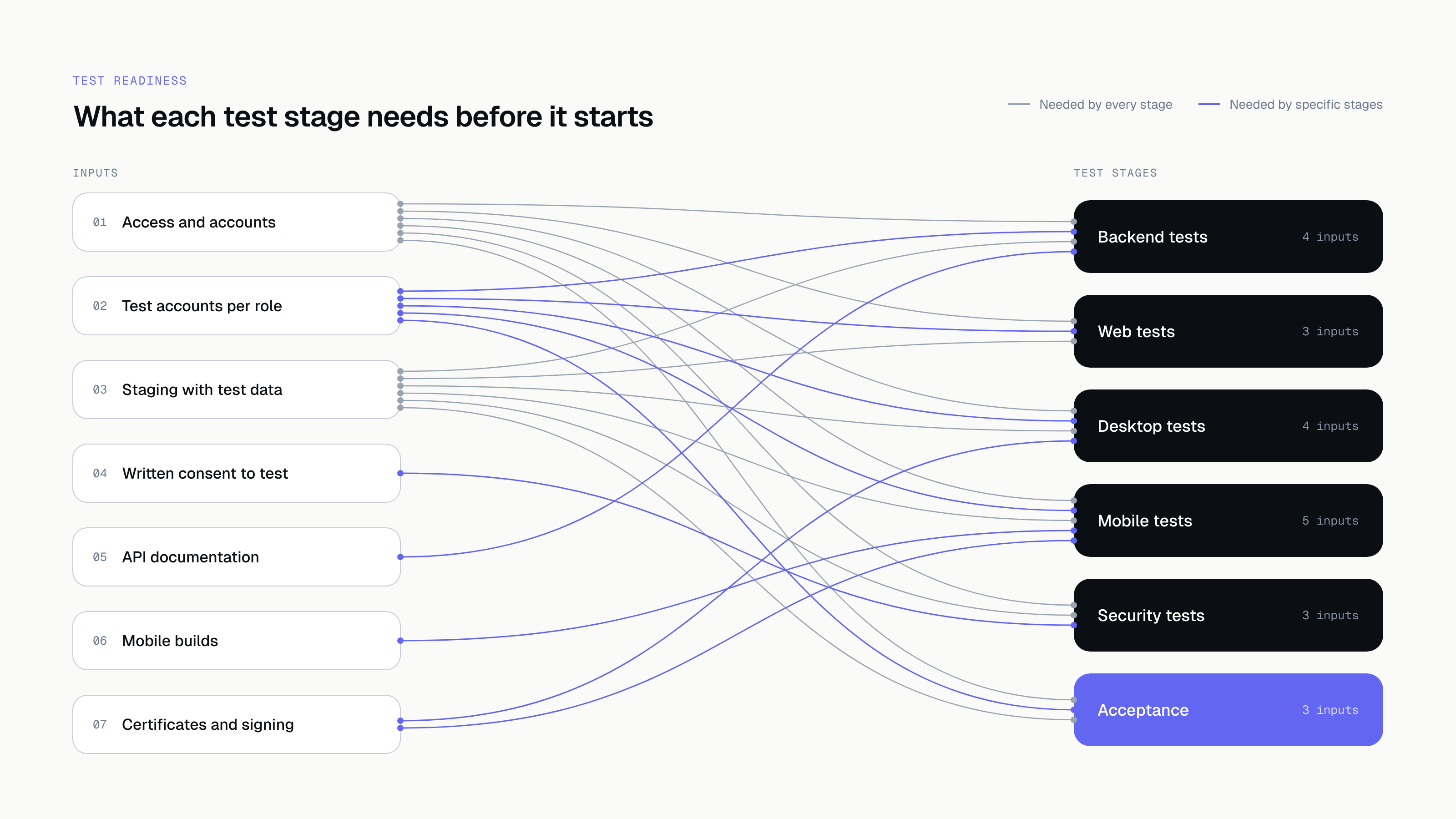
Dependency graph: what must exist to start
Every stage has an input. If one is missing, the stage waits. Check the Owner column: that is how much sits on your side.
Which input unlocks which stage.
Requirement
Blocks stages
Owner
AccessRepository, hosting panel, admin panels, app store accounts.
All stages
Client
Test accountsOne account per user role, with data they are allowed to see.
Backend tests, Frontend tests, Acceptance tests
Client
Staging with test dataAn environment separate from production. Never production with customer data.
All stages
Client
Consent to testWritten consent with a time window, scope and an emergency contact.
Integration and security
Together
API documentationAn OpenAPI spec or an endpoint description with sample requests.
Backend tests
Client
Mobile buildsInstallable files for iOS and Android, ideally through TestFlight and a test channel.
Frontend tests
Client
Certificates and signingApp signing certificates, provisioning profiles, signing keys.
Frontend tests
Client
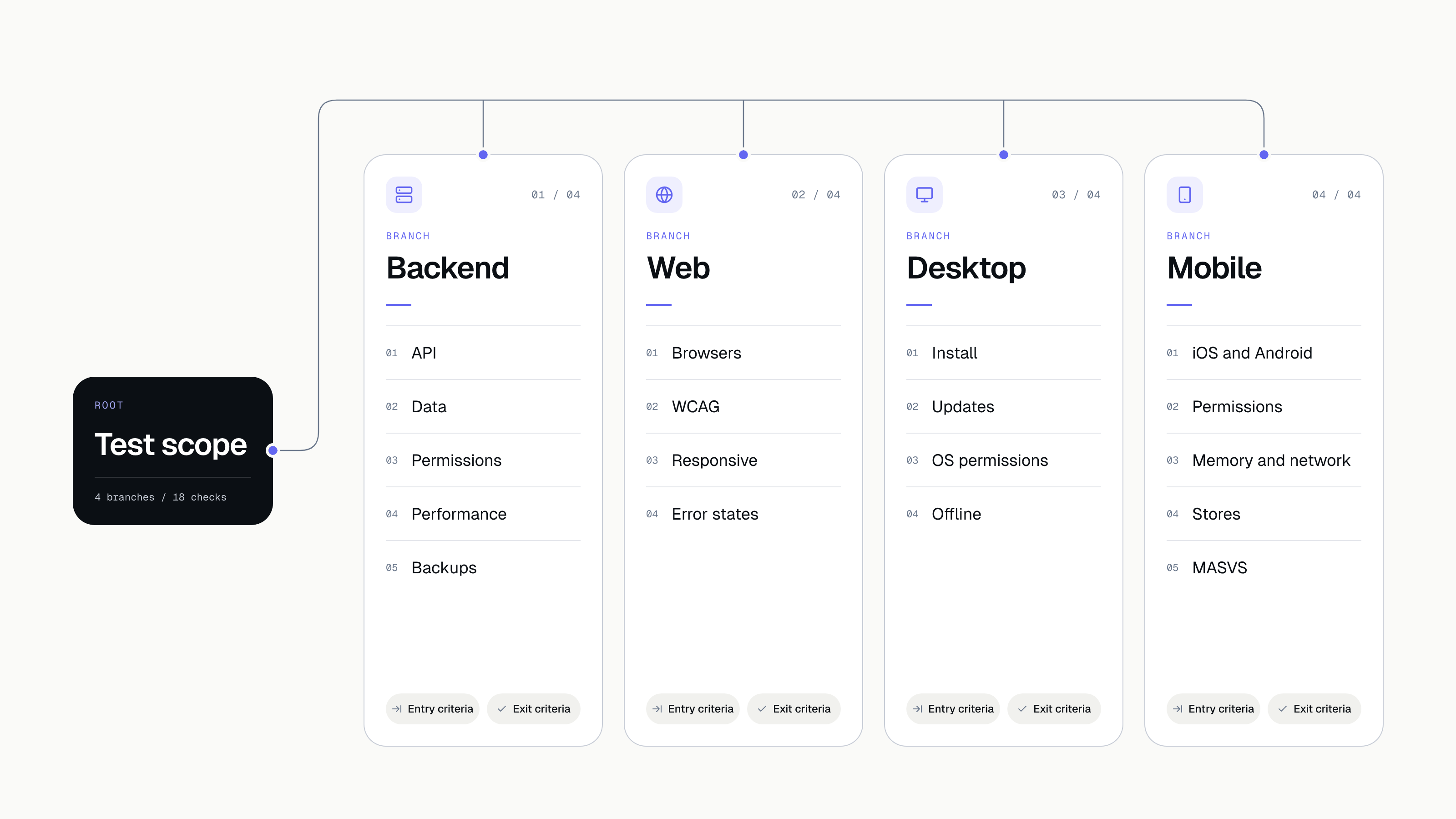
Detailed branches
For each branch we define scope, tools, and entry and exit criteria. We enter a branch only when its entry criteria are met.
Four test branches and their scope.
Backend
Scope
API: contract, error codes, limits
Data: consistency, migrations, validation
Permissions: roles, data isolation between companies
[NEED: desktop app stack, e.g. Electron, Tauri or native]
Entry criteria
Installer signed with a certificate
Access to the update channel
List of supported OS versions
Exit criteria
Install and update work on every supported version
The app asks only for needed permissions
Offline work does not lose data
Mobile app
Scope
iOS and Android on real devices
Permissions: camera, location, notifications
Memory, battery and weak network
App Store and Google Play requirements
Security to OWASP MASVS
Tools
TestFlight and the Google Play internal test channel
Xcode and Android Studio
OWASP MASTG
MobSF
Entry criteria
Test build on both platforms
Store accounts and certificates
Backend tested
Exit criteria
Key paths work on the devices in scope
Sensitive data sits in keychain or keystore
Store requirements checked before submission
Roles: who is responsible for what
A RACI matrix for every stage. Deliver means preparing the input. Decide means owning the outcome. Test means running the tests. Sign means confirming the stage is done.
Role split across the seven stages.
Stage
Delivers
Decides
Tests
Signs
Preparation
Client
Together
Hindbrain
Client
Backend tests
Client
Hindbrain
Hindbrain
Hindbrain
Frontend tests
Client
Hindbrain
Hindbrain
Hindbrain
Integration and security
Client
Hindbrain
Hindbrain
Hindbrain
Acceptance tests
Together
Client
Client
Client
Report and retest
Hindbrain
Client
Hindbrain
Together
Go-live decision
Hindbrain
Client
Together
Client
Interactive checklist
Tick items off during the project. State is saved only in this browser. Each item has an owner: Client, Hindbrain or Together. You can print the full list as a separate document.
 hindbrain